What Are Ice Hockey Gloves?
Ice hockey gloves are an essential piece of protective equipment designed to protect a player’s hands, fingers, wrists, and parts of the forearms while allowing enough flexibility to control the hockey stick.
Hockey gloves must provide a balance between protection, mobility, comfort, grip, and durability. Players use their hands constantly during a game, whether shooting, passing, stickhandling, checking, or battling for the puck. A properly fitted pair of gloves helps players perform these movements safely and effectively.
Main Parts of an Ice Hockey Glove
A typical ice hockey glove consists of several important protective sections:
1. Palm
The palm is the part of the glove that directly contacts the hockey stick. It is usually made from durable synthetic or leather-like materials designed to provide a secure grip while maintaining good stick feel.
The palm is also one of the areas that experiences the most wear, particularly for players who frequently practice stickhandling or shooting.
2. Fingers
The fingers are protected by padded sections that help reduce the impact of sticks, pucks, and contact with other players.
The glove must allow the fingers to bend naturally so that players can maintain control of the stick without excessive restriction.
3. Backhand Protection
The backhand area contains protective padding, commonly using foam and other impact-absorbing materials.
This section protects the back of the hand from impacts caused by sticks, pucks, falls, and physical contact.
4. Cuff
The cuff protects the wrist and lower forearm while allowing the player to move the wrist during shooting, passing, and stickhandling.
Different glove designs offer different cuff lengths and levels of mobility. Players generally choose a style based on their position, playing style, and personal preference.
5. Thumb Protection
The thumb is particularly important because it is essential for gripping and controlling the hockey stick.
Many modern hockey gloves include reinforced thumb protection and flexible construction to help reduce the risk of injury while maintaining mobility.
Why Are Hockey Gloves Important?
Hockey gloves provide several important functions during a game:
- Protect the hands and fingers from impacts.
- Reduce the risk of cuts and abrasions.
- Protect the wrists and lower forearms.
- Improve grip and control of the hockey stick.
- Allow players to maintain hand mobility.
- Provide comfort during extended periods of play.
- Help protect against contact with sticks, pucks, boards, and other players.
Because hockey is a fast and physical sport, gloves should always be considered an essential part of a player’s protective equipment.
Types of Hockey Gloves
Hockey gloves are generally designed according to the player’s role and level of play.
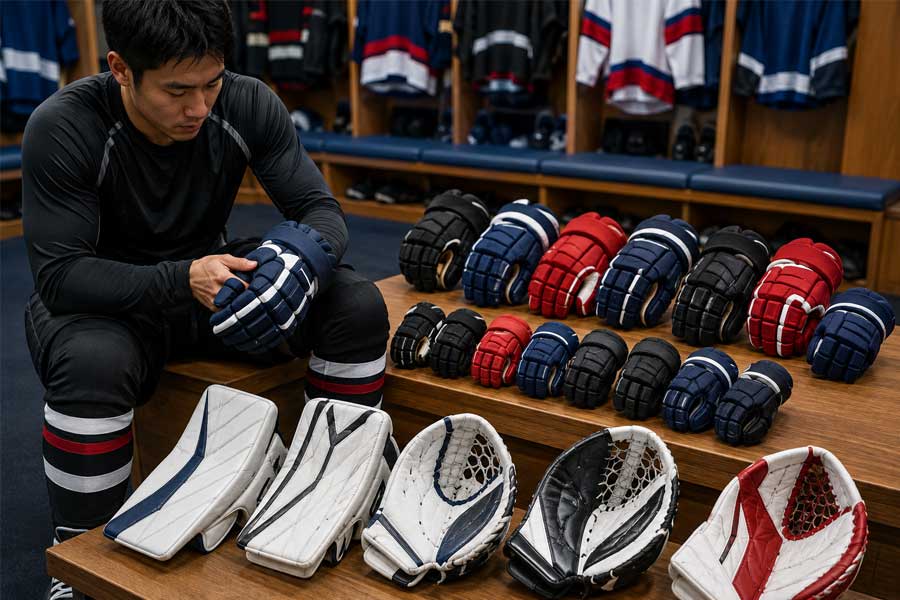
Player Gloves
Player gloves are designed for forwards, defensemen, and other skaters. They emphasize a combination of protection and flexibility.
Different models may have different finger lengths, cuff designs, palm materials, and levels of padding.
Players should choose gloves that allow natural hand movement while providing adequate protection.
Goaltender Gloves
Goaltenders use specialized gloves that are significantly different from regular player gloves.
A goaltender normally uses two different types:
ถุงมือรับลูก (Catcher Glove) — worn on the hand opposite the blocker. It has a large catching pocket designed to catch and control the puck.
Blocker Glove — worn on the stick hand. It includes a large protective blocking surface that helps the goaltender deflect or stop shots.
Because goaltender gloves have specialized functions, they should not be treated as interchangeable with standard player gloves.
How Should Hockey Gloves Fit?
Proper fit is extremely important.
A hockey glove should feel secure without being excessively tight. The fingers should sit comfortably inside the finger stalls, while the player should still be able to bend and move the fingers naturally.
A glove that is too large may reduce stick control, while a glove that is too small may restrict movement and cause discomfort.
When trying on gloves, players should:
- Check that the fingers reach comfortably into the finger stalls.
- Make sure the thumb can move naturally.
- Check that the wrist can move freely.
- Hold a hockey stick to test grip and control.
- Move the hands as if passing, shooting, and stickhandling.
- Make sure there are no uncomfortable pressure points.
Hockey Gloves and Safety
Hockey gloves are an important component of the overall protective system, but they cannot prevent every injury.
Players should use gloves together with other appropriate protective equipment, including a helmet, shoulder pads, elbow pads, hockey pants, shin guards, skates, and a mouthguard where appropriate.
Gloves should also be inspected regularly. Damaged padding, torn palms, loose stitching, broken protective components, or significant wear may reduce their effectiveness.
Caring for Hockey Gloves
Proper maintenance can help extend the life of hockey gloves.
After playing:
- Allow gloves to dry completely.
- Remove excess moisture whenever possible.
- Avoid leaving wet gloves inside a closed hockey bag.
- Check the palms and stitching regularly.
- Clean the gloves according to the manufacturer’s instructions.
- Repair or replace heavily damaged gloves.
Good ventilation is particularly important because gloves can accumulate sweat and moisture during training and competition.
Choosing the Right Hockey Gloves
When selecting hockey gloves, players should consider:
Protection — Does the glove provide adequate impact protection?
Fit — Does it fit securely without restricting movement?
Mobility — Can the fingers, thumb, and wrist move naturally?
Grip — Does the palm provide good contact with the hockey stick?
Comfort — Can the gloves be worn comfortably throughout a game or training session?
Durability — Can the materials withstand regular use?
The best glove is not necessarily the most expensive model. The right glove is the one that provides an appropriate combination of protection, fit, mobility, comfort, and performance for the individual player.
Gloves Are an Essential Part of Hockey Equipment
Ice hockey gloves play a critical role in protecting one of the most important parts of a player’s body: the hands.
Whether playing recreational hockey, youth hockey, amateur competition, or high-level hockey, players should use properly fitted and well-maintained gloves.
For goaltenders, specialized catcher and blocker gloves provide additional protection and functionality required for the unique demands of the position.
Protect your hands. Improve your control. Play hockey with confidence.