HOLDING IN ICE HOCKEY
REFEREE SIGNALS — OFFICIAL GAME SIGNAL
What is Holding?
Holding (การเหนี่ยวรั้ง) is an infraction in ice hockey that occurs when a player restrains or impedes the progress of an opposing player, regardless of whether the opponent has possession of the puck.
Under IIHF Rule 54 — Holding, a player may not use their hands, arms, or legs to hold or restrict an opponent’s movement.
Holding can occur in many situations, including along the boards, in front of the net, during a battle for position, or while an opponent is attempting to skate into open ice.
When is Holding Called?
A referee may call Holding when a player:
- Grabs an opponent with their hand or arm.
- Restrains an opponent’s movement with their arms.
- Uses their legs to prevent an opponent from skating freely.
- Prevents an opponent from reaching the puck by physically holding them.
- Deliberately restricts an opponent’s progress rather than playing the puck.
The key consideration is whether the player’s action restrains or impedes the opponent’s progress.
Body Position vs. Holding
Not every physical contact is considered Holding.
A player is permitted to use their arm as part of a legitimate strength move when they have established body position, provided they are not using their hands in a holding manner.
This distinction is important because legal body positioning and illegal holding can look similar during a fast-paced play.
Holding the Stick
A player is also prohibited from holding an opponent’s stick.
Under the IIHF rules, holding an opponent’s stick is assessed as a minor penalty and is announced as “Holding the Stick.” A player may defend themselves against an opponent’s stick, but must release it immediately and allow normal play to continue.
REFEREE SIGNAL — HOLDING
Official Signal
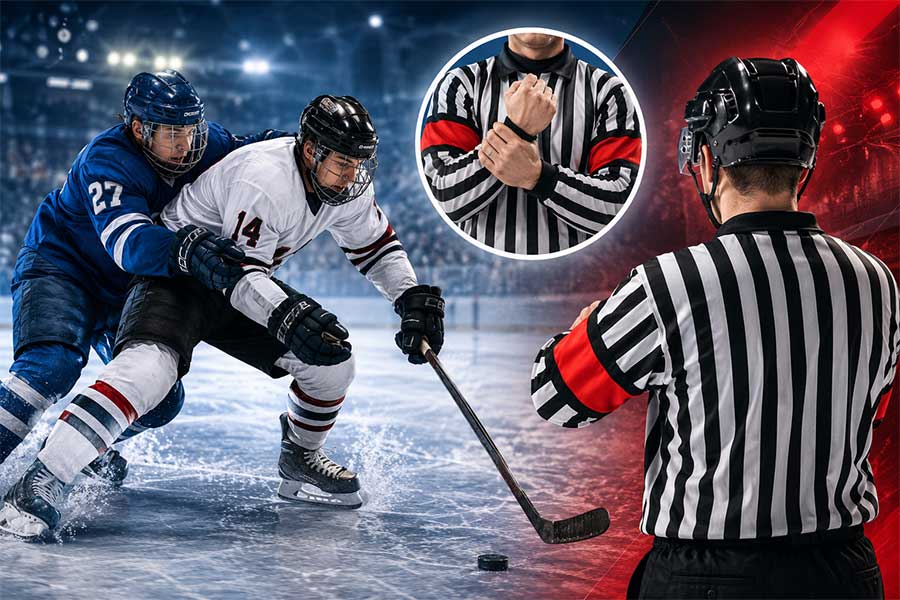
The referee signals Holding (การเหนี่ยวรั้ง) by:
Clasping one wrist with the opposite hand in front of the chest.
This is the official IIHF game-official signal for Rule 54 — Holding.
How to Recognize the Signal
When you see the referee:
- Bring both hands toward the chest.
- Use one hand to clasp the opposite wrist.
- Hold the position clearly so players, coaches, and spectators can recognize the call.
This signal communicates that a player has been penalized for restraining or impeding an opponent.
PENALTY FOR HOLDING
Under IIHF Rule 54.2, a player who holds an opponent using their hands, arms, or legs is subject to a Minor Penalty (โทษเบา).
The referee may stop play and assess the penalty according to the circumstances of the infraction.
Why the Rule Matters
Holding is designed to prevent players from gaining an unfair advantage by restricting an opponent’s ability to skate, defend, receive a pass, or pursue the puck.
Without this rule, a player could gain an advantage simply by physically preventing an opponent from participating in the play.
HOLDING vs. OTHER INFRACTIONS
Holding can sometimes be confused with other restraining infractions.
Holding (การเหนี่ยวรั้ง)
Uses the hands, arms, or legs to restrain an opponent.
Holding the Stick
A player deliberately holds an opponent’s stick.
Hooking (การเกี่ยว)
Uses the stick to restrain or impede an opponent.
Interference (การกีดขวาง)
Impeding an opponent who does not have possession of the puck.
Understanding these differences helps players, coaches, officials, and spectators better understand why a particular penalty has been called.
QUICK GUIDE
INFRACTION: Holding (การเหนี่ยวรั้ง)
IIHF RULE: Rule 54
SIGNAL: One wrist clasped by the opposite hand in front of the chest
TYPICAL PENALTY: Minor Penalty (โทษเบา)
MAIN PURPOSE: Prevent players from restraining or impeding an opponent illegally
Remember
“Play the puck, not the player.”
Good ice hockey allows players to compete physically while respecting the boundaries of the rules. Understanding referee signals helps everyone follow the game more clearly and appreciate the decisions made on the ice.