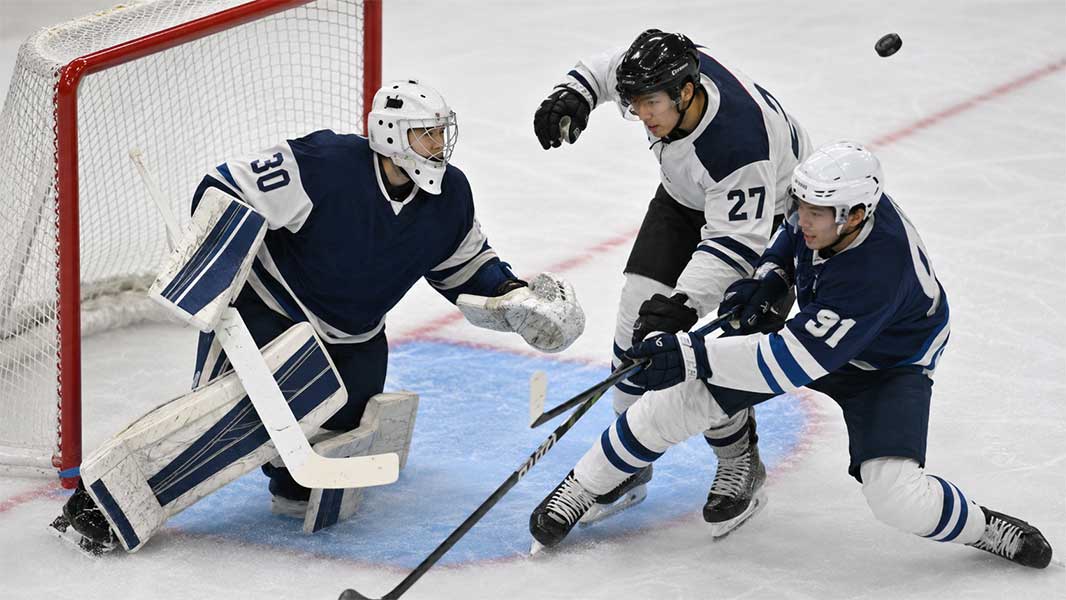
What is Interference?
Interference (การกีดขวาง) is a restraining infraction in ice hockey that occurs when a player obstructs or prevents an opponent who is not in possession of the puck from skating, receiving a pass, or moving freely on the ice.
Under the IIHF rules, players are expected to compete for position through skating and legitimate body position. A player cannot use their stick, free hand, body, or other illegal means to prevent an opponent from reaching the puck or moving into an area of play.
Interference is designed to protect the flow of the game and ensure that players who do not have the puck are still able to move freely and participate in the play.
Common Examples of Interference
Interference can occur in several situations, including:
- Blocking an opponent who does not have possession of the puck.
- Preventing an opponent from skating toward the puck.
- Using the body to impede an opponent without first establishing a legitimate body position.
- Moving laterally into an opponent without establishing body position.
- Holding or restraining an opponent who is attempting to forecheck.
- Deliberately checking a player who is no longer considered to be in possession of the puck — commonly referred to as a late hit.
- Preventing a player from recovering their dropped stick or equipment in certain situations.
- A player from the bench interfering with an opponent or the puck.
Body Position and Interference
One of the most important concepts when judging interference is body position.
A player is generally entitled to the ice they occupy. A player who is skating in front of or beside an opponent and traveling in the same direction may use their body position to block or lengthen the opponent’s route.
However, a player cannot simply move laterally into an opponent and make contact without first establishing proper body position.
Players are also not permitted to use their stick, free hand, or other illegal actions to artificially maintain or establish body position.
Key principle:
A player may use legitimate body position — but may not illegally restrain an opponent.
This distinction is particularly important when determining whether physical contact is a legal body position play or an interference infraction.
REFEREE SIGNAL
Interference Signal
When calling Interference (การกีดขวาง), the Referee uses the designated interference signal to communicate the infraction to the players, coaches, officials, and spectators.
Signal Description
The Referee brings the arms across the front of the body in a crossed-arm motion, clearly indicating that an opponent has been illegally obstructed or prevented from participating freely in the play.
The signal is normally accompanied by the whistle and followed by the appropriate penalty announcement.
What the Signal Means
“A player has illegally obstructed or impeded an opponent who was not in possession of the puck.”
Penalty for Interference
The standard penalty for interference is a Minor Penalty (โทษเบา).
Depending on the circumstances and severity of the infraction, additional or more severe penalties may apply. Under the IIHF rules, reckless interference that endangers an opponent may result in a Major Penalty (โทษหนัก), and in particularly serious circumstances a Major Penalty plus Game Misconduct may be assessed.
Interference can also involve players or team personnel on the bench. Depending on whether the individual can be identified, the appropriate penalty can be assessed as a player penalty or a Bench Minor Penalty.
Interference vs. Legal Physical Contact
Not every collision between players is interference.
A player may legally compete for position and make legitimate physical contact when the opponent is in possession of the puck and the contact complies with the rules.
The key questions for officials include:
- Who has possession of the puck?
- Was the opponent attempting to play the puck?
- Was legitimate body position established?
- Did the player use illegal means to restrain the opponent?
- Was the contact a late hit?
Correct interpretation of these factors is essential when determining whether contact should be considered legal play or interference.
INTERFERENCE — QUICK GUIDE
| ประเภทการแข่งขัน | Possible Ruling |
|---|---|
| Obstructing a player without the puck | Interference (การกีดขวาง) |
| Blocking an opponent after establishing legal body position | Generally legal |
| Moving laterally into a player without body position | Interference (การกีดขวาง) |
| Using the stick or free hand to restrain an opponent | Interference (การกีดขวาง) |
| Deliberate late hit on a player no longer in possession | Interference / Late Hit |
| Reckless interference that endangers an opponent | Major penalty or additional penalty |