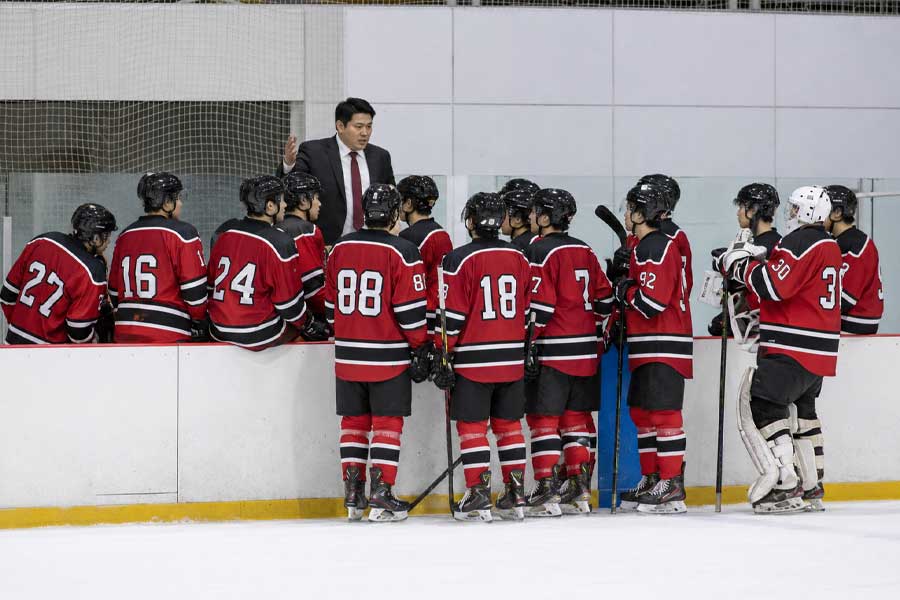
In ice hockey, a Time-Out is a temporary stoppage in play requested by a team and granted by the referee according to the applicable competition rules.
REFEREE SIGNAL
The referee signals a Time-Out by using both hands to form the letter “T” in front of the chest.
This is one of the standard game-official signals used to clearly communicate to players, coaches, the timekeeper, and spectators that a team time-out has been granted.
HOW THE SIGNAL IS PERFORMED
- The referee stops play when appropriate.
- The referee brings both hands together in front of the chest.
- The hands are positioned to form the shape of a “T.”
- The signal indicates that a Time-Out has been granted.
- The game timekeeper records and manages the duration of the time-out.
WHEN CAN A TEAM REQUEST A TIME-OUT?
Under the IIHF rules, a team may request its time-out during an appropriate stoppage in play and before the referee has completed the player-change procedure and indicated the face-off location.
The request must therefore be made at the correct time. A team cannot simply request a time-out after the face-off procedure has already been completed.
IMPORTANT RESTRICTIONS
The IIHF rules include situations in which a time-out is not permitted. For example:
- A time-out cannot be granted following a face-off violation.
- A defensive team cannot be granted a time-out following icing.
- A defensive team cannot be granted a time-out following certain goalkeeper-caused stoppages from a shoot-in beyond the center red line.
- A time-out cannot be granted when a defending player accidentally dislodges the goal and causes a stoppage.
- Once the referee has awarded a Penalty Shot and given the required instructions to the shooter and defending goalkeeper, a time-out cannot be granted.
- A time-out is not permitted during a shootout.
Specific competition regulations may also contain additional provisions, so teams and officials should always follow the current rules governing their competition.
WHY IS THE TIME-OUT SIGNAL IMPORTANT?
The “T” signal provides a simple and universally recognizable visual indication that the stoppage is a Time-Out rather than an ordinary stoppage in play.
Clear communication between the referee, players, coaches, and off-ice officials is essential for maintaining the correct flow of the game.
QUICK REFERENCE
Signal: Both hands form a “T” in front of the chest.
Meaning: Time-Out.
Official: Referee.
Purpose: Indicates that a team time-out has been granted.
Official Rule Reference: IIHF Rule Book — Game Official Signals, Rule 87 — TIME-OUT. The IIHF signal is performed by using both hands to form a “T” in front of the chest.