
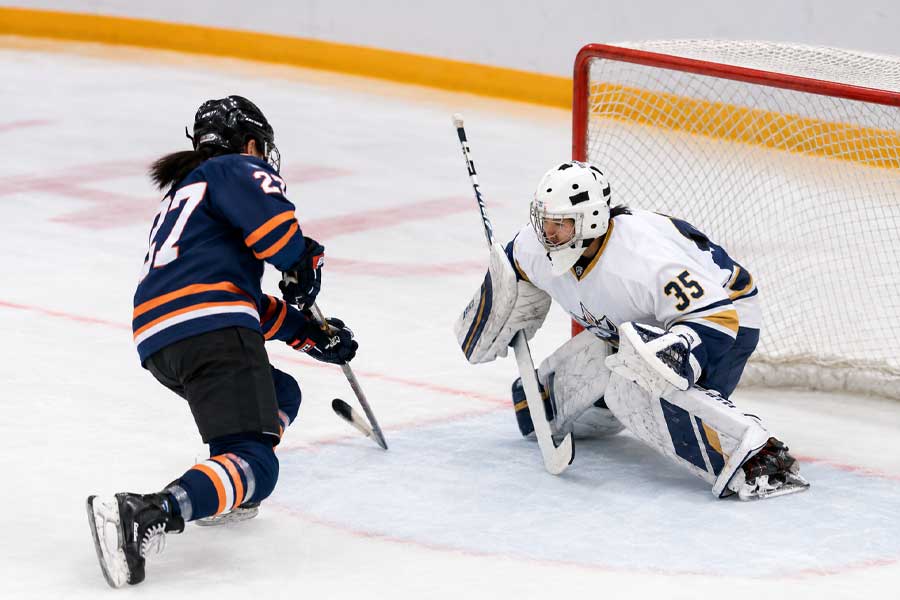
The GOAL signal is used by the referee to indicate that a goal has been legally scored.
After the puck completely crosses the goal line between the goal posts and below the crossbar, the referee signals the goal by pointing toward the center of the ice. This signal confirms that the goal has been counted and the play will proceed with a face-off at center ice.
Referee Signal
Signal: The referee points toward the center of the ice with one arm.
Meaning: A legal goal has been scored and the goal is awarded.
When Is the Goal Signal Used?
The referee gives the GOAL signal when:
- The puck completely crosses the goal line.
- The goal is scored according to the rules of play.
- No rule violation has occurred that would disallow the goal.
- The officials have determined that the goal should count after reviewing the play, when video review is available.
Important Point
The GOAL signal indicates that the goal has been awarded. However, the referee may need to communicate with the other officials or conduct a video review before play resumes if there is uncertainty about the play.
A goal may be disallowed if, for example, the puck was deliberately directed into the net by a hand or the attacking team committed an infraction that affected the play.
Why Is the GOAL Signal Important?
The GOAL signal provides a clear and immediate visual indication to players, coaches, scorekeepers, and spectators that a goal has been awarded.
Understanding this signal helps everyone quickly recognize the outcome of an important scoring play and follow the referee’s decision.
GOAL — QUICK REFERENCE
Signal: Pointing toward center ice
Meaning: Goal awarded
Result: The goal is counted and play restarts with a face-off at center ice.