yes

Ice Hockey Rink

Ice Hockey Rink

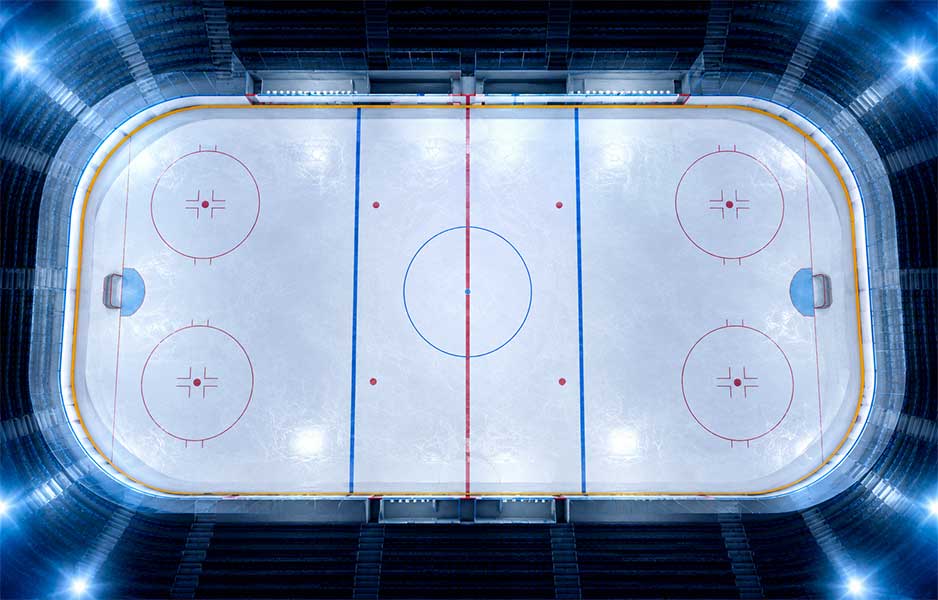
An ice hockey rink is the enclosed ice surface where ice hockey is played. It is surrounded by boards and protective glass and contains specific lines, circles, zones, goals, benches, and penalty boxes.

🏒 Main Areas of an Ice Hockey Rink

  1. Center Ice – The middle of the rink, marked by the center face-off circle.
  2. Center Red Line – Divides the rink into two halves.
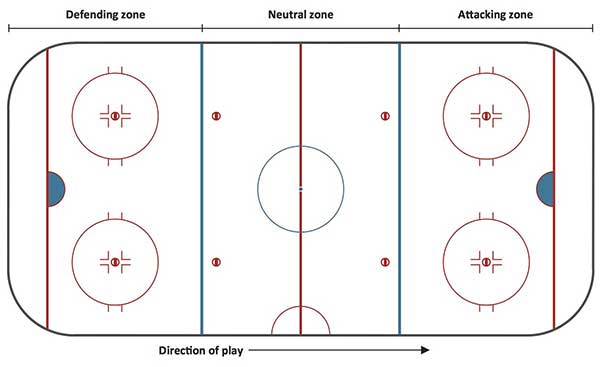
  3. Blue Lines – Two blue lines divide the rink into three zones:
    • เขตป้องกัน (Defensive Zone)
    • Neutral Zone
    • Attacking Zone (เขตรุก)
  4. Goal Lines – Located near each end of the rink.
  5. Face-Off Circles – Used for face-offs at the start of play and after certain stoppages.
  6. Goal Crease – The marked area immediately in front of each goal where the goaltender operates.
  7. Goals – Each team defends one goal and attempts to score in the opponent’s goal.
  8. Boards & Protective Glass – Surround the ice and keep the puck and players within the playing area.
  9. Players’ Benches – Where players and team staff sit during the game.
  10. Penalty Boxes – Where players serve penalties.

📏 Rink Dimensions

Under the current IIHF rules, the official rink is 60 meters long and 26–30 meters wide, with rounded corners having a radius of 7.0–8.5 meters. (IIHF Blob)

The IIHF rink is therefore generally wider than the typical NHL playing surface, while maintaining the same 60 m length used for international competition. (IIHF Blob)
❄️ Rink Surface

The playing surface is a white sheet of ice maintained at a consistent quality suitable for competition. The official markings include the red center line, blue lines, goal lines, face-off spots and circles, and goal creases. (IIHF Blob)

For a website article, a good title structure would be:

Ice Hockey Rink: Layout, Dimensions, Zones & Markings
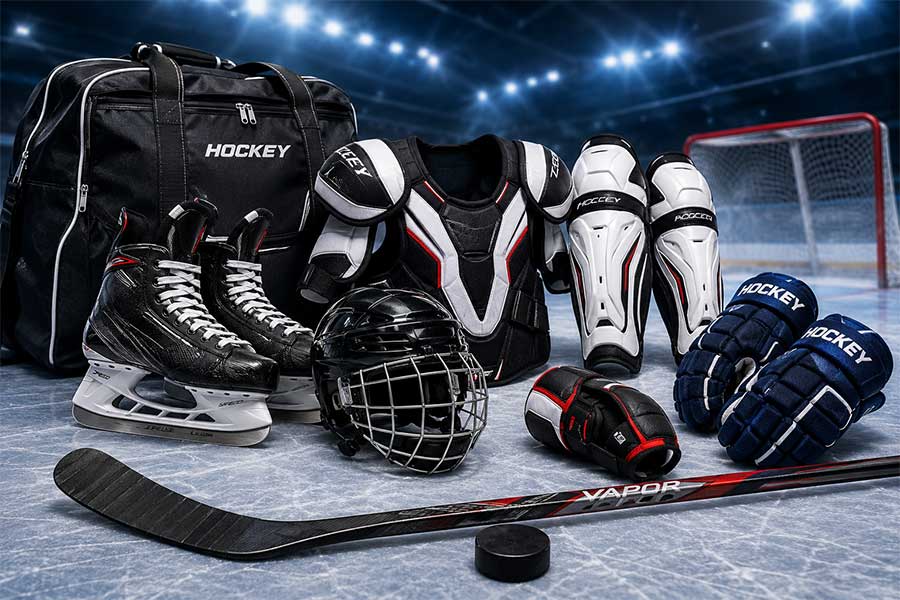
Ice Hockey Equipment

Ice Hockey Equipment

Ice hockey requires specialized equipment designed to provide protection, comfort, mobility, and performance on the ice. Whether you are a beginner or an experienced player, wearing the correct equipment is essential for safety and confidence.

1. Hockey Helmet

A hockey helmet protects the head from impacts caused by falls, collisions, sticks, and pucks. Players should use a properly fitted helmet with an appropriate face protection system, such as a cage or visor.

2. Shoulder Pads

Shoulder pads protect the shoulders, chest, upper back, and upper arms. They are designed to absorb impact while allowing players to move their arms freely.

3. Elbow Pads

Elbow pads protect the elbows and forearms from falls and collisions. They should fit securely without restricting movement.

4. Hockey Gloves

Hockey gloves protect the hands, fingers, and wrists while providing flexibility for gripping the stick and controlling the puck.

5. Hockey Pants

Hockey pants provide protection for the hips, thighs, lower back, and upper legs. They help absorb impacts during falls and contact with other players.

6. Shin Guards

Shin guards protect the shins and knees from pucks, sticks, and collisions. Properly fitted shin guards should cover the knee and extend down toward the top of the skate.

7. Hockey Skates

Hockey skates are specially designed for speed, balance, quick turns, and acceleration on ice. A good pair of skates should fit snugly and provide strong ankle support.

8. Hockey Stick

The hockey stick is used to control, pass, shoot, and handle the puck. Sticks are available in different lengths, flex ratings, materials, and blade patterns.

9. Hockey Jersey

The hockey jersey is worn over the protective equipment and identifies the team and player number. It is designed to provide freedom of movement during play.

10. Protective Cup

A protective cup provides protection for the groin area. It is an important piece of protective equipment for players of all levels.

11. Neck Guard

A neck guard helps protect the neck and throat area, particularly from skate blades and other sharp equipment. It is especially important for younger players.

12. Hockey Socks

Hockey socks are worn over the shin guards and typically extend from the ankle area to the upper thigh. They are usually secured with hockey tape or a hockey garter system.

13. Mouthguard

A mouthguard helps protect the teeth, lips, cheeks, and mouth from impacts. It can also reduce the risk of certain dental injuries.

Essential Equipment Checklist

Helmet → Shoulder Pads → Elbow Pads → Gloves → Hockey Pants → Shin Guards → Skates → Stick → Jersey → Protective Cup → Neck Guard → Hockey Socks → Mouthguard

For Beginners

If you are just starting ice hockey, the most important thing is to make sure your equipment fits correctly. Equipment that is too large, too small, or improperly adjusted can reduce both protection and mobility. A qualified hockey equipment specialist or coach can help with proper fitting.

Ice Hockey Positions

Ice Hockey Positions

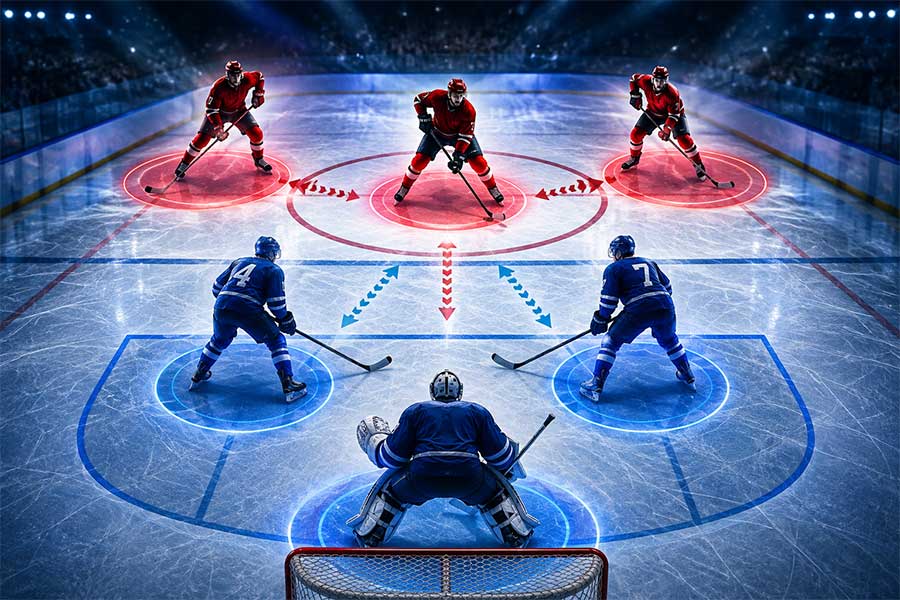
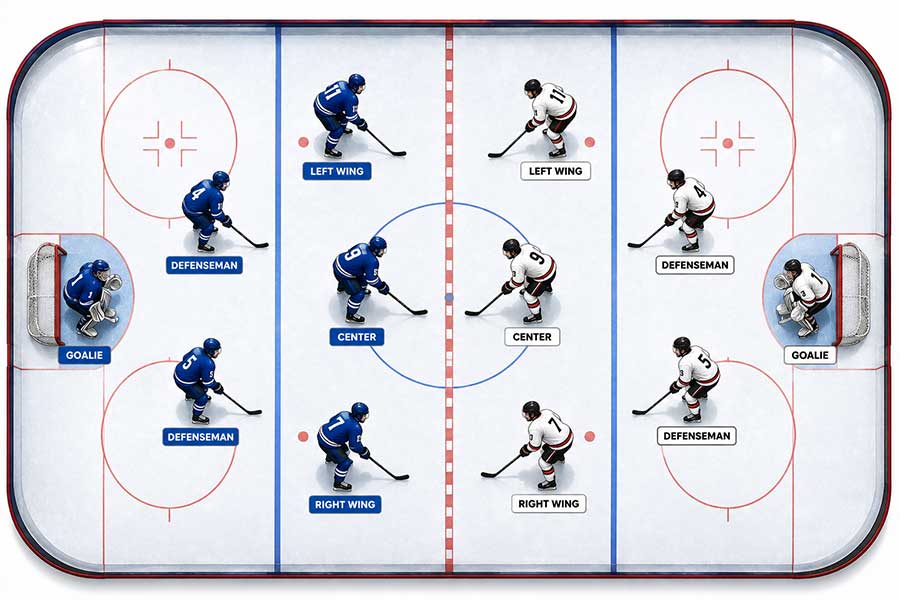
In ice hockey, each team typically has six players on the ice: three forwards, two defensemen, and one goaltender.

  • 🥅 Goaltender (Goalie) — Protects the net and stops the opposing team from scoring.
  • 🏒 🎯 เซ็นเตอร์ (Center) — Plays in the middle of the forward line, takes faceoffs, creates plays, and helps both attack and defense.
  • Left Wing — Plays primarily on the left side and focuses on attacking, shooting, and supporting the center.
  • Right Wing — Plays primarily on the right side and contributes to scoring, forechecking, and defensive support.
  • 🛡️ Left Defenseman — Protects the defensive zone, blocks shots, wins the puck, and starts offensive plays.
  • 🛡️ Right Defenseman — Works with the other defenseman to protect the goal and move the puck out of the defensive zone.

Simple formation:

Positions can change quickly during play, so players must communicate and work together as a team.

How to Play Ice Hockey

How to Play Ice Hockey

Ice hockey is a fast-paced team sport played on an ice rink. The goal is to score more goals than the opposing team by shooting a puck into the opponent’s net.

🏒 Basic Rules

  • Teams: Each team typically has 6 players on the ice—5 skaters and 1 goaltender.
  • Objective: Shoot the puck into the opponent’s goal to score.
  • Game structure: A standard game is divided into three periods.
  • Movement: Players use ice skates to move around the rink and use hockey sticks to control and pass the puck.
  • Passing: Players can pass the puck to teammates using their sticks.
  • Shooting: Players attempt to score by shooting the puck past the opposing goaltender.
  • Body contact: Physical contact is permitted in some forms and under specific rules, depending on the competition and age level.
  • Offside: Players cannot enter the attacking zone ahead of the puck.
  • Icing: A player generally cannot shoot the puck from behind the center red line all the way past the opponent’s goal line without it being touched, subject to the applicable rules.

🥅 How a Team Scores

A goal is scored when the entire puck crosses the goal line between the goalposts and underneath the crossbar.

👥 Player Positions

The main positions are:

  • Goaltender (Goalie) – Protects the net.
  • 🛡️ กองหลัง (Defensemen) – Defend their own zone and help move the puck forward.
  • Forwards – Attack and create scoring opportunities. The three forward positions are center, left wing, and right wing.

⚡ How the Game Works

Players constantly transition between offense and defense. A team may try to maintain possession, pass the puck around the offensive zone, create a shooting opportunity, and score. When possession is lost, the team immediately switches to defense and attempts to regain the puck.

กล่าวอย่างง่าย ๆ คือ:
Skate → Control the puck → Pass → Attack → Shoot → Score! 🏒🥅

What Is Ice Hockey?

🏒 What Is Ice Hockey?

Ice hockey is a fast-paced team sport played on an ice rink. Two teams compete to score goals by shooting a rubber puck into the opponent’s net using hockey sticks.

Each team typically has six players on the ice at a time:

  • 🥅 1 Goaltender
  • 🏒 5 Skaters — usually a combination of forwards and defensemen

Players wear protective equipment—including a helmet, gloves, shoulder pads, elbow pads, shin guards, and skates—because the game is played at high speed and involves physical contact.

❄️ How the Game Works

Players use their sticks to pass, control, and shoot the puck while skating around the rink. The team that scores the most goals by the end of the game wins.

Ice hockey is known for its:
Speed • Skill • Teamwork • Strategy • Courage • Sportsmanship

For young players, ice hockey is also a great way to develop skating ability, coordination, discipline, confidence, and teamwork.

History of Ice Hockey

🏒 History of Ice Hockey

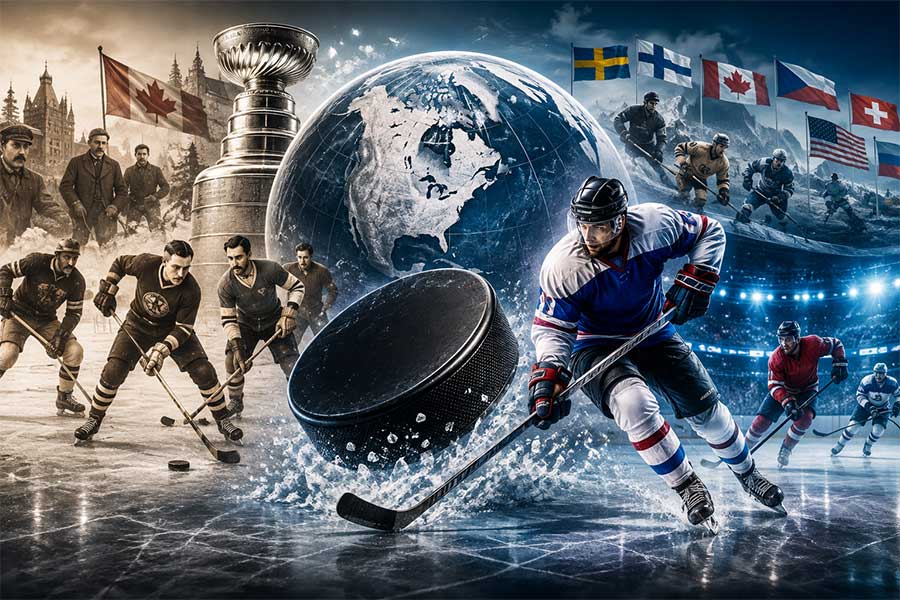
Ice hockey is a fast-paced team sport played on ice, combining skating, puck control, passing, shooting, and physical play. Its origins can be traced to stick-and-ball games played in Europe centuries ago, but the modern form of ice hockey developed in Canada during the 19th century.

🇨🇦 Origins of Modern Ice Hockey

Early versions of hockey-like games were played in countries such as England, Ireland, and Scotland. When European settlers brought these games to Canada, they adapted them to the cold climate and frozen lakes and ponds.

By the 1800s, organized ice hockey began to emerge in Canada. One of the earliest documented organized games was played in Montreal in 1875, helping establish many of the rules and traditions associated with modern hockey.

🏒 Development of the Rules

As the sport became more popular, teams and organizations began creating standardized rules. In the late 19th and early 20th centuries, hockey spread rapidly throughout Canada and then into the United States and Europe.

Important developments included:

  • Standardized team sizes and playing rules
  • The introduction of the hockey puck
  • Defined rink dimensions
  • Organized leagues and championships
  • Development of professional hockey

🏆 The NHL

The National Hockey League (NHL) was founded in 1917 in Canada. It eventually became the world’s most prominent professional ice hockey league, with teams from both Canada and the United States.

The Stanley Cup, first awarded in 1893, became the championship trophy associated with the highest level of professional hockey in North America.

🌍 Ice Hockey Around the World

Ice hockey gradually became an international sport. European countries including Sweden, Finland, Russia, Czechia, Slovakia, Switzerland, and Germany developed strong hockey traditions.

The sport also became part of the Winter Olympic Games, with men’s ice hockey making its Olympic debut at the 1920 Summer Olympics and later becoming a permanent Winter Olympic sport.

Women’s ice hockey has also grown significantly. It was officially added to the Winter Olympics in 1998, helping expand opportunities for female players around the world.

🇹🇭 Ice Hockey in Thailand

Although Thailand has a tropical climate, ice hockey has developed steadily through indoor ice rinks, youth programs, clubs, and organized competitions.

Today, Thai players of different ages can participate in training programs, youth leagues, recreational hockey, and international competitions. The growth of ice hockey in Thailand demonstrates that the sport can thrive even outside traditional cold-weather countries.

🥅 Ice Hockey Today

Modern ice hockey is played at many levels—from children’s introductory programs and amateur leagues to professional and international competition.

The sport continues to evolve through improvements in equipment, training, sports science, rink technology, and coaching while maintaining its fundamental identity:

Skate. Shoot. Pass. Compete. And never stop playing.