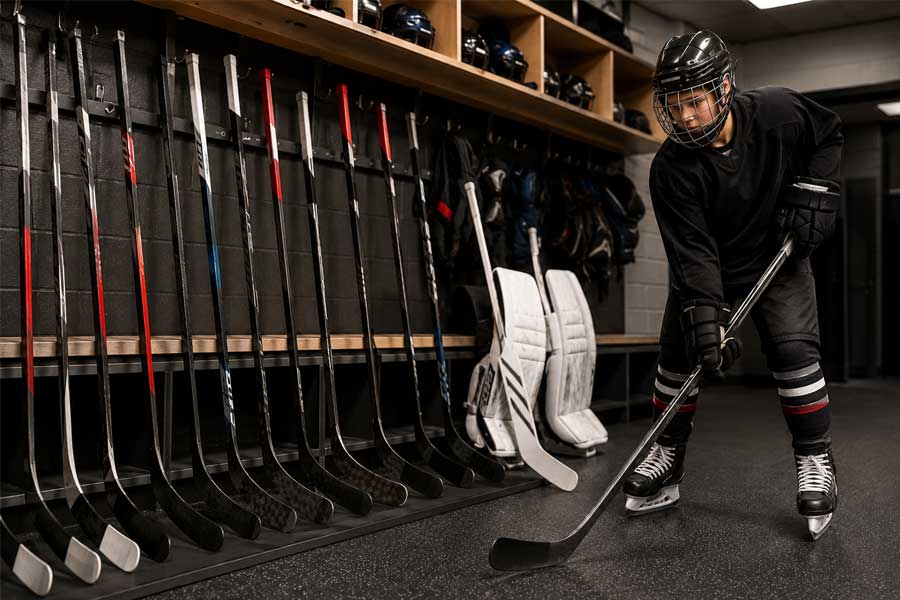
The Hockey Stick is one of the most important pieces of equipment in ice hockey. It is used by players to control, pass, carry, shoot, and handle the puck, while goaltenders use a specially designed stick to stop shots and control the puck around the goal crease.
Modern hockey sticks are designed to be lightweight, strong, and responsive. Choosing the right stick can significantly affect a player’s shooting power, puck control, passing accuracy, and overall performance on the ice.
1. Hockey Stick for Players
A standard player hockey stick consists of two main sections:
- Shaft – The long section that the player holds with both hands.
- Blade – The curved lower section that makes contact with the puck.
Player sticks are available in different lengths, flex ratings, blade patterns, and materials. These characteristics allow players to select a stick that matches their age, body size, playing style, and position.
Stick Length
The correct stick length is important for puck control and skating posture. A stick that is too long or too short can make handling the puck more difficult.
Young players generally use shorter and lighter sticks, while adult players usually use longer sticks with specifications suited to their strength and playing style.
Stick Flex
Flex describes how much the shaft bends when force is applied to it.
A lower flex number generally means the stick bends more easily, while a higher flex number requires more force to load the shaft.
Choosing the right flex depends on factors such as:
- Player’s body size and strength
- Shooting technique
- Playing position
- Personal preference
A properly selected flex can help players generate better shot speed while maintaining control and consistency.
Blade Pattern and Curve
The blade is available in different curve patterns and face angles. These differences affect:
- Puck control
- Passing
- Wrist shots
- Snap shots
- Slap shots
- Backhand control
Players often choose a blade pattern based on their position and individual playing style.
2. Types of Player Hockey Sticks
Wooden Hockey Sticks
Wooden sticks are traditional and are still used by some recreational players and beginners. They are generally durable and provide a familiar feel when handling the puck.
Composite Hockey Sticks
Composite sticks are made from materials such as carbon fiber and other lightweight composites. They are widely used in modern competitive hockey because they provide a combination of low weight, stiffness, and energy transfer.
Composite sticks are commonly available as:
- One-piece sticks
- Two-piece stick systems
Modern professional and competitive players frequently use lightweight composite sticks for improved shooting performance and puck handling.
3. Hockey Stick for Goaltenders
A Goaltender Stick, also called a goalie stick, is significantly different from a regular player stick.
The lower portion of a goalie stick has a much wider blade designed to help the goaltender block shots and control rebounds. The shaft is also designed to provide a strong grip and allow the goaltender to move the puck when necessary.
A goaltender may use the stick to:
- Block shots
- Deflect pucks away from the net
- Control rebounds
- Cover the lower part of the goal
- Pass or clear the puck
- Move the puck to teammates
Goaltender sticks are available in different sizes and designs to accommodate different player heights and preferences.
4. Choosing the Right Hockey Stick
When selecting a hockey stick, players and parents should consider several important factors:
Age and Height
The stick should be appropriate for the player’s age, height, and physical development. Youth sticks are shorter and lighter, making them easier for young players to control.
Weight
A lighter stick can make puck handling and shooting easier, while the overall construction must still provide sufficient durability for the player’s level of play.
Flex
The flex should match the player’s strength and shooting technique. The correct flex allows the player to load the stick effectively during a shot.
Position and Playing Style
Forwards, defensemen, and goaltenders may have different preferences.
For example, an offensive player may prioritize a stick that provides quick release and good puck control, while a defenseman may prefer characteristics that support powerful shots and passing.
Handedness
Players need to select a stick based on whether they shoot left-handed or right-handed.
Handedness refers to which hand is positioned lower on the shaft when the player holds the stick in a normal shooting position.
5. Hockey Stick Safety and Care
A hockey stick can experience significant stress during shooting, passing, checking, and contact with other sticks or the boards. Players should regularly inspect their sticks for damage.
Check for:
- Cracks in the shaft
- Damage to the blade
- Loose or damaged tape
- Splinters on wooden sticks
- Visible damage to composite materials
A damaged stick should be replaced when it is no longer safe or reliable for play.
Players should also avoid leaving sticks in extreme heat or direct sunlight for extended periods, as excessive heat can affect some materials and construction components.
6. Stick Tape
Many players use hockey tape on the blade and shaft.
Tape on the blade can help provide additional grip and improve the player’s feel for the puck. Tape on the shaft can improve grip and help protect the surface of the stick.
Players may use different taping techniques depending on personal preference and playing style.
7. Hockey Stick for Different Age Groups
Hockey sticks are generally available in different categories to suit players of different ages and sizes, such as:
- Youth – Designed for very young players
- Junior – Designed for younger developing players
- Intermediate – Designed for teenagers and smaller players
- Senior – Designed primarily for adult players
The exact specifications vary between manufacturers, so players should always check the manufacturer’s size and flex recommendations.
Conclusion
The Hockey Stick is a fundamental piece of ice hockey equipment for both players and goaltenders. The right stick can help improve puck control, passing, shooting, and overall confidence on the ice.
When choosing a hockey stick, players should consider length, weight, flex, blade pattern, handedness, playing position, and skill level. Most importantly, the stick should be comfortable, appropriate for the player’s size, and suitable for their style of play.