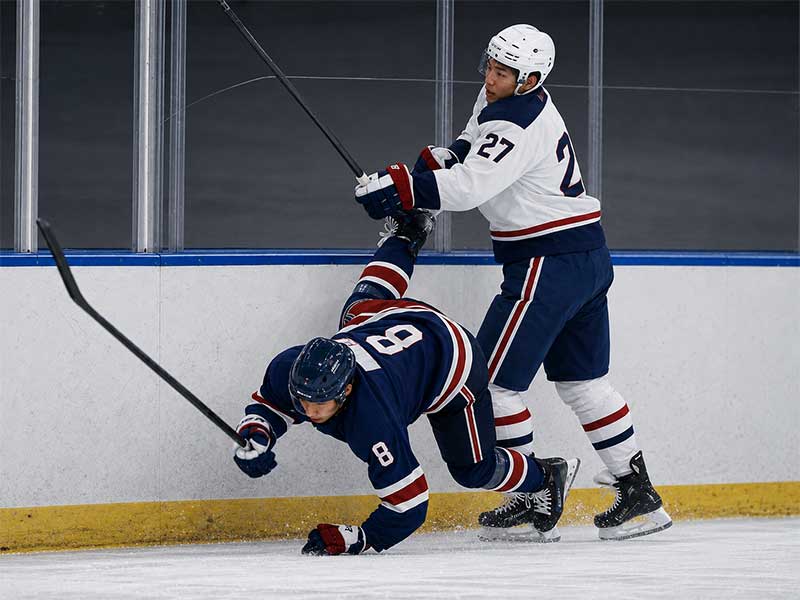
Charging is a physical infraction in ice hockey that occurs when a player delivers an illegal body check by taking excessive steps or distance, jumping or leaving their feet, or otherwise violently checking an opponent.
Under IIHF Rule 42 – Charging, a charge may occur when a player takes several strides or travels an excessive distance immediately before making contact, with the purpose of delivering the hit, or when the player violently checks an opponent. A charge may occur in open ice, against the boards, or into the goal frame.
What Is Charging?
Charging is intended to prevent players from generating excessive momentum specifically to deliver a dangerous or unnecessary hit.
A player may be penalized for Charging when the check involves factors such as:
- Taking several strides immediately before contact.
- Traveling an excessive distance to deliver the hit.
- Jumping or leaving the ice to make contact.
- Delivering a violent or unnecessary check.
- Making a check that recklessly endangers an opponent.
The Referee evaluates the overall circumstances, including the force, violence, distance traveled, and manner in which the contact was delivered.
Charging vs. Legal Body Checking
Not every strong body check is Charging.
A legal body check can involve significant physical contact when it is delivered within the rules. Charging is generally associated with excessive momentum, distance, force, or an unnecessarily violent manner of checking.
The Referee must assess the circumstances of each play rather than simply judging the intensity of the contact.
Charging and the Goalkeeper
A goalkeeper is protected from unnecessary contact while in the goal crease.
Under the IIHF rules, a player who charges a goalkeeper while the goalkeeper is within the goal crease may be penalized. A goalkeeper is not automatically considered fair game simply because they are outside the crease. Incidental contact may be permitted when the goalkeeper is playing the puck outside the crease, provided the attacking player makes a reasonable effort to avoid the contact.
Penalties for Charging
The severity of the penalty depends on the circumstances and the degree of danger involved.
Minor Penalty
The Referee may assess a minor penalty for Charging based on the degree of force and violence of the check.
Major Penalty
A major penalty may be assessed when the player recklessly endangers the opponent and a minor penalty would not be sufficient.
Major Penalty + Game Misconduct
In more serious cases, a major penalty combined with a game misconduct penalty may be imposed when the Charging is considered reckless and sufficiently severe.
Additional disciplinary measures may also be applied by the appropriate authorities when warranted.
REFEREE SIGNAL — Charging
How the Referee Signals Charging
The official IIHF signal for Charging is:
The Referee rotates clenched fists around one another in front of the chest.
Signal Description
🇬🇧 English:
Rotating clenched fists around one another in front of the chest.
This distinctive motion is used by the Referee to communicate that a Charging infraction has been called.
Why Is the Signal Important?
Referee signals allow players, coaches, spectators and scorekeepers to quickly understand the reason for a stoppage or penalty.
The Charging signal is particularly useful because physical-contact penalties can occur very quickly during a game. The standardized signal provides a clear visual explanation of the call.
The IIHF emphasizes the importance of positioning, observation and teamwork among game officials when making decisions on the ice.
Quick Reference — Charging
| Item | Details |
|---|---|
| Rule | Rule 42 – Charging |
| Type | Physical Infraction |
| Typical Situation | Excessive distance, momentum or violent checking |
| Possible Location | Open ice, boards or goal frame |
| Minor Penalty | Possible |
| Major Penalty | Possible |
| Game Misconduct | Possible in serious cases |
| Referee Signal | Rotating clenched fists around one another |
| Signal Position | In front of the chest |
Official Signal: 🔄 Rotating clenched fists around one another in front of the chest.