What Is Delay of Game?
Delay of Game is a penalty in ice hockey that occurs when a player or team deliberately causes a stoppage of play or otherwise interferes with the normal flow of the game.
Under the current IIHF Official Rule Book 2026/27, Rule 63 — Delaying the Game, a player or team may be penalized when, in the opinion of the Referee, they delay the game in any manner.
The purpose of this rule is to prevent players or teams from deliberately wasting time, stopping play unnecessarily, or gaining an unfair advantage by interrupting the normal progress of the game.
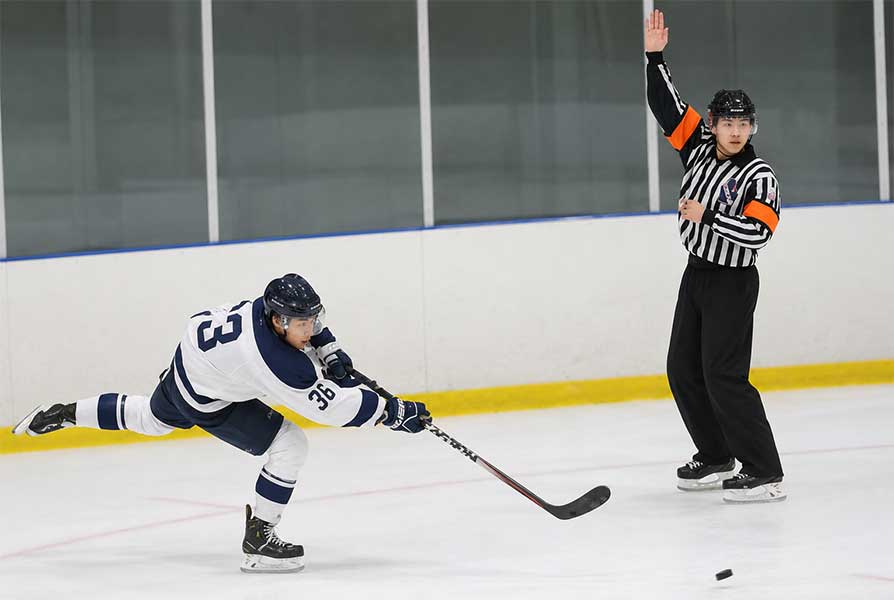
REFEREE SIGNAL — DELAY OF GAME
When calling a Delay of Game penalty, the Referee uses the designated penalty signal to communicate the infraction to the players, benches, other officials, and spectators.
The signal is made by bringing the non-whistle hand across the chest and then extending the arm forward.
The signal indicates that a player has been assessed a minor penalty for Delay of Game.
Penalty: Minor Penalty — 2 minutes
The exact signal should be interpreted together with the Referee’s verbal call and the specific situation that caused the stoppage.
COMMON SITUATIONS THAT CAN RESULT IN DELAY OF GAME
Under IIHF Rule 63.2, a minor penalty for Delay of Game can be assessed in several situations.
1. Deliberately Freezing the Puck
A player, including a goalkeeper in situations covered by the rule, may be penalized for deliberately holding, freezing, or playing the puck with the stick, skates, or body in a manner intended to cause a stoppage of play.
For a goalkeeper, this provision applies when outside the goal crease area.
2. Deliberately Shooting or Batting the Puck Out of Play
A player may receive a penalty for deliberately shooting or batting the puck outside the playing area, whether during play or after a stoppage of play.
This can include intentionally using the hand, leg, foot, arm, or stick to send the puck out of the playing area.
3. Shooting the Puck Directly Out of the Playing Surface
A minor penalty can be assessed when a player shoots or bats the puck directly, without it being deflected, out of the playing surface from the defending zone in situations where protective glass is present.
The determining factor is the position of the puck when the player made contact with it.
4. Deliberately Displacing the Goal Post
A player who deliberately moves the goal post from its normal position may be penalized for Delay of Game.
The Referee stops play when the offending team gains control of the puck. In certain situations involving an imminent scoring opportunity on an open net, the Referee may award a goal under the applicable rule.
5. Deliberately Falling on or Covering the Puck
A player other than the goalkeeper may be penalized if they deliberately fall on or gather the puck into their body.
However, a player who drops to their knees to block a shot is not automatically penalized if the puck is simply shot underneath them or becomes lodged in them as part of the play.
WHY IS DELAY OF GAME PENALIZED?
The rule exists to protect the pace, fairness, and continuity of the game.
Without this rule, a team could intentionally:
- Waste valuable playing time
- Stop play repeatedly
- Prevent an opponent from developing an attack
- Gain a tactical advantage by sending the puck out of play
- Deliberately prevent the game from restarting normally
The penalty therefore discourages intentional delays and helps maintain the flow of the game.
EXAMPLE SITUATION
Situation:
A defending player is under pressure in their own zone. Instead of making a normal clearing play, the player deliberately shoots the puck directly over the protective glass and out of the playing area.
Referee’s Decision:
The Referee stops play and assesses a Minor Penalty — Delay of Game, provided the situation meets the requirements of Rule 63.2.
Result:
The offending team plays shorthanded for two minutes, subject to the normal penalty administration rules.
IMPORTANT NOTE
Not every puck that leaves the playing area automatically results in a Delay of Game penalty.
The Referee must determine whether the action meets the conditions of the rule. For example, the IIHF rule specifically distinguishes between a puck deliberately sent out of play and situations where the puck leaves the playing area without the required deliberate action.
Therefore, players, coaches, and spectators should consider how and where the puck was played, rather than simply whether the puck went out of the rink.
DELAY OF GAME — QUICK REFERENCE
| Item | Information |
|---|---|
| Rule | IIHF Rule 63 |
| Infraction | Delaying the Game |
| Penalty | Minor Penalty |
| Penalty Time | 2 minutes |
| Called By | Referee |
| Common Examples | Deliberately sending puck out of play, deliberately freezing puck, deliberately displacing goal post, covering puck |
| Purpose | Prevent intentional delays and preserve game flow |
REFEREE SIGNALS — WHY THEY MATTER
Referee signals are an essential part of ice hockey officiating. Because games are fast and noisy, visual signals allow officials to communicate decisions clearly to players, coaches, scorekeepers, broadcasters, and spectators.
The IIHF provides official materials and procedures to promote consistent officiating and interpretation of the rules.
Understanding the Delay of Game signal helps everyone watching or participating in the game recognize when a stoppage has resulted from a specific rule violation.
SUMMARY
Delay of Game is designed to prevent deliberate actions that unnecessarily stop or slow the game.
When the Referee determines that a player has intentionally delayed play in a manner covered by the rule, a Minor Penalty of two minutes may be assessed.
Knowing the referee signal and understanding the situations covered by IIHF Rule 63 helps players, coaches, officials, and fans better understand the decisions made during an ice hockey game.