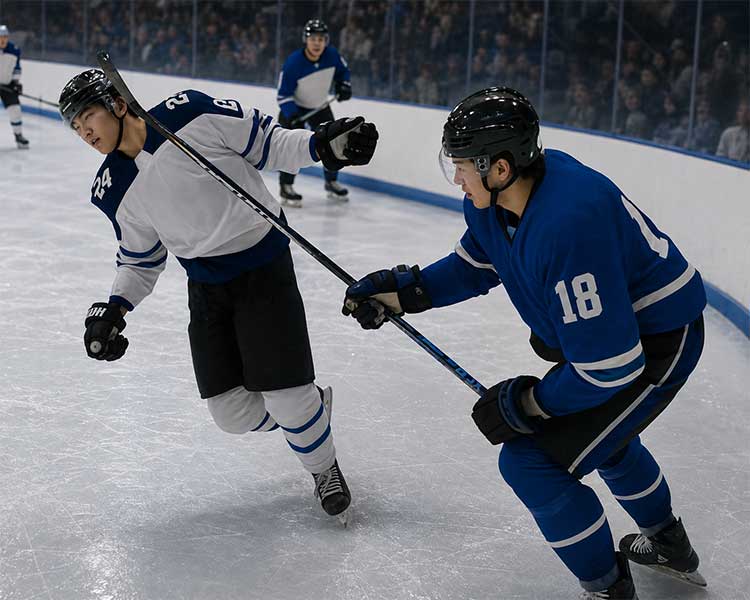
High-Sticking is a stick infraction in ice hockey that occurs when a player carries or uses the stick above the height of the opponent’s shoulders and makes contact with an opponent.
Players are responsible for maintaining control of their sticks at all times. Contact above the shoulders is generally prohibited, although the rules recognize certain situations involving accidental contact during a normal shooting motion or face-off.
REFEREE SIGNAL — HIGH-STICKING
The referee signals High-Sticking by raising one arm straight above the head with the hand closed into a fist.
This signal indicates that a player has committed a high-sticking infraction and that a penalty may be assessed.
WHEN IS HIGH-STICKING PENALIZED?
Under the IIHF rules, contact by a stick on an opponent above the shoulders is prohibited.
Depending on the circumstances and severity of the incident, the penalty can include:
- Minor Penalty — for prohibited contact with an opponent above the shoulders.
- Double-Minor Penalty — when contact with the neck, face or head results in an injury, such as bleeding.
- Major Penalty / Game Misconduct — where the referee determines that the player recklessly endangered the opponent.
- Match Penalty — may be assessed in circumstances involving particularly serious and reckless endangerment under the applicable rules.
IMPORTANT EXCEPTION
Not every instance in which a stick is above shoulder height is automatically a penalty.
For example, accidental contact that occurs as part of a normal wind-up or follow-through of a shooting motion, or accidental contact with an opposing center who is bent over during a face-off, can be treated differently under the rules.
However, a wild or uncontrolled swing that is not part of a normal shooting motion may still be penalized.
HIGH-STICKING vs. HIGH-STICKING THE PUCK
These two terms should not be confused.
High-Sticking
Contact between a player’s stick and an opponent above the shoulders.
➡️ This is a stick infraction and can result in a penalty.
High-Sticking the Puck
Batting or contacting the puck with the stick above the normal height of the shoulders.
Under the current IIHF Rule Book, play is normally stopped when a player high-sticks the puck and the puck subsequently comes into the possession and control of a player from the offending team. There are specific exceptions, including when the puck is batted to an opponent or when a defending player bats the puck into their own goal.
WHY THE SIGNAL IS IMPORTANT
The referee signal provides a clear visual indication to:
- Players
- Coaches
- Team staff
- Scorekeepers
- Spectators
- Broadcast audiences
that the officials have identified a High-Sticking infraction.
Understanding referee signals helps everyone follow the game and understand why play has been stopped or why a penalty has been assessed.
QUICK REFERENCE
| Item | High-Sticking |
|---|---|
| Type | Stick infraction |
| Basic violation | Stick makes contact with opponent above the shoulders |
| Referee signal | Arm raised above the head, closed fist |
| Possible penalty | Minor / Double-Minor / Major & Game Misconduct / Match Penalty depending on circumstances |
| Key consideration | Height, nature of contact, injury and degree of recklessness |
Reference: IIHF Official Rule Book 2026/27, Rule 60 — High-Sticking. The IIHF identifies the latest published Rule Book as the applicable ruleset for its competitions.