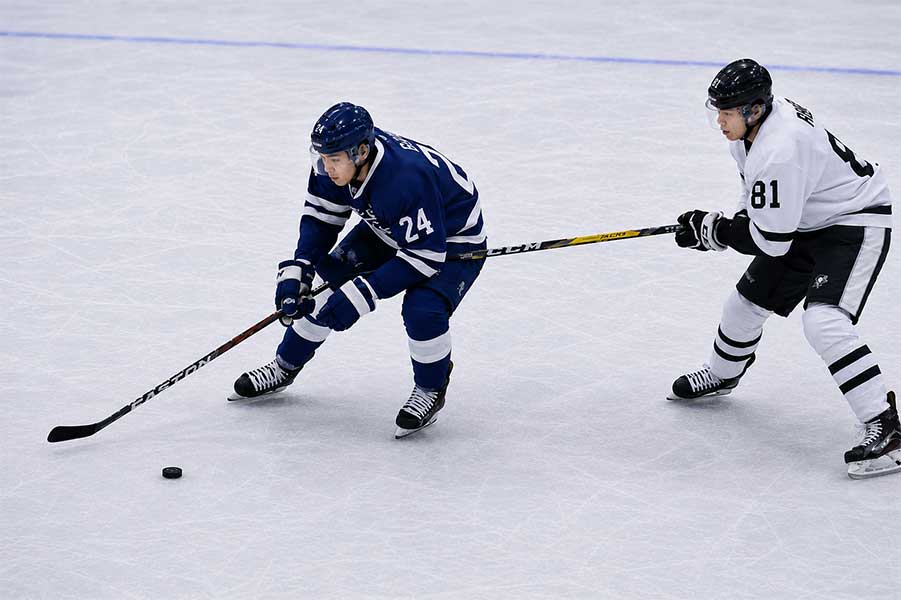
Hooking is a stick infraction in ice hockey that occurs when a player uses the stick in a way that restrains or impedes the progress of an opposing player.
Under the current IIHF Rule Book, Hooking is defined as using the stick to restrain an opponent. If the stick is used against or near an opponent’s hands, the action may be penalized as hooking. However, simple stick-to-stick contact during a legitimate checking action is not considered hooking.
🚨 What Does Hooking Look Like?
A Hooking penalty may occur when a player:
- Uses the blade or shaft of the stick to catch or hook an opponent.
- Wraps the stick around an opponent’s body or arm to slow them down.
- Uses the stick to restrict an opponent’s skating movement.
- Uses the stick around or against the opponent’s hands to prevent normal play.
- Gains an advantage by using the stick to restrain an opponent rather than legally playing the puck.
The key point is that the stick is being used to restrain or impede the opponent, rather than simply making normal stick contact.
🏁 Referee Signal — How Is Hooking Signaled?
When a referee calls Hooking, the official uses the designated hooking signal.
The signal is made by moving one arm in a hooking motion, representing the action of using the hockey stick to hook or restrain an opponent.
This visual signal allows players, coaches, spectators and other game officials to quickly identify the type of infraction being called.
🟨 Penalty for Hooking
Under IIHF Rule 55, a standard Hooking infraction results in a Minor Penalty when a player impedes an opponent’s progress by hooking with the stick. The rule also specifically addresses the use of the stick shaft above the upper hand to hold or hook an opponent.
In more serious situations, the referee may assess a Major Penalty plus an automatic Game Misconduct when the hooking is reckless and endangers the fouled player to a degree that a minor penalty would not sufficiently address.
🏒 Hooking vs. Legal Stick Contact
Not every stick contact is a Hooking penalty.
For example:
Legal:
A player uses the stick to challenge an opponent’s stick and there is only stick-to-stick contact during a legitimate play.
Hooking:
A player uses the stick to catch, wrap, pull, or restrain an opponent, particularly around the hands or body, preventing the opponent from skating freely.
The distinction is whether the stick is being used as part of a legitimate hockey play or as a means of restraining the opponent.
👨⚖️ Why Is Hooking Penalized?
Hooking can give a player an unfair advantage by reducing an opponent’s ability to skate, control the puck or create a scoring opportunity.
Because ice hockey is played at high speed, restricting an opponent with the stick can also create dangerous situations. IIHF emphasizes that officials assess physical play based on the nature of the action and whether it recklessly endangers an opponent.
📌 Quick Reference
| Item | Details |
|---|---|
| Infraction | Hooking |
| Rule | IIHF Rule 55 |
| Equipment involved | Hockey stick |
| Main action | Using the stick to restrain or impede an opponent |
| Typical penalty | Minor Penalty |
| Serious cases | Major Penalty + automatic Game Misconduct, at referee’s discretion |
| Referee | Signals the infraction using the Hooking signal |