Ice Hockey Rink
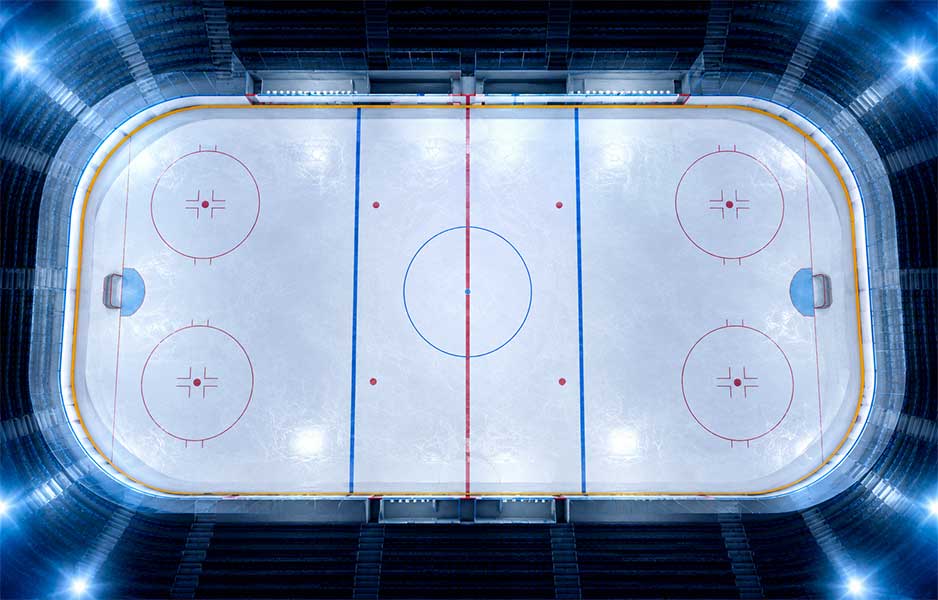
An ice hockey rink is the enclosed ice surface where ice hockey is played. It is surrounded by boards and protective glass and contains specific lines, circles, zones, goals, benches, and penalty boxes.
🏒 Main Areas of an Ice Hockey Rink
- Center Ice – The middle of the rink, marked by the center face-off circle.
- Center Red Line – Divides the rink into two halves.
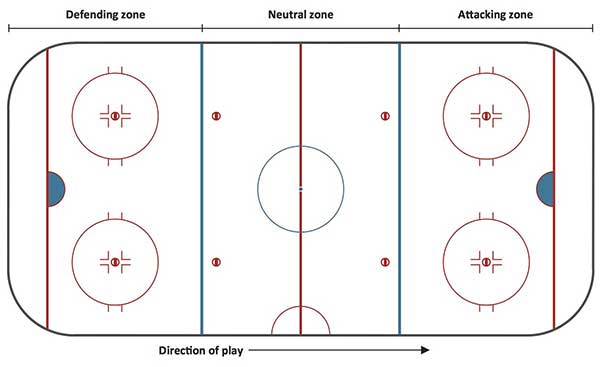
- Blue Lines – Two blue lines divide the rink into three zones:
- Defensive Zone
- Neutral Zone
- Attacking Zone
- Goal Lines – Located near each end of the rink.
- Face-Off Circles – Used for face-offs at the start of play and after certain stoppages.
- Goal Crease – The marked area immediately in front of each goal where the goaltender operates.
- Goals – Each team defends one goal and attempts to score in the opponent’s goal.
- Boards & Protective Glass – Surround the ice and keep the puck and players within the playing area.
- Players’ Benches – Where players and team staff sit during the game.
- Penalty Boxes – Where players serve penalties.
📏 Rink Dimensions
Under the current IIHF rules, the official rink is 60 meters long and 26–30 meters wide, with rounded corners having a radius of 7.0–8.5 meters. (IIHF Blob)
The IIHF rink is therefore generally wider than the typical NHL playing surface, while maintaining the same 60 m length used for international competition. (IIHF Blob)
❄️ Rink Surface
The playing surface is a white sheet of ice maintained at a consistent quality suitable for competition. The official markings include the red center line, blue lines, goal lines, face-off spots and circles, and goal creases. (IIHF Blob)
For a website article, a good title structure would be:
Ice Hockey Rink: Layout, Dimensions, Zones & Markings