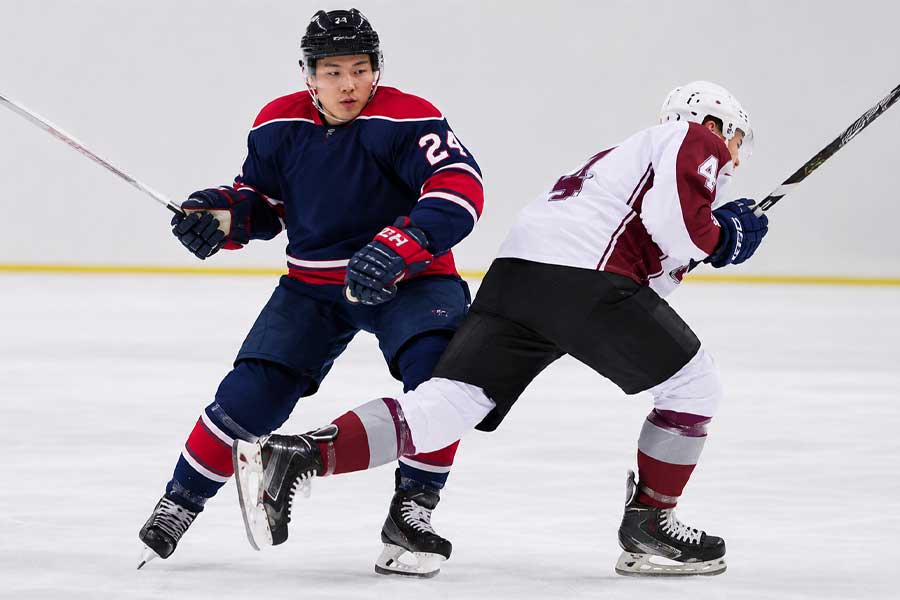
Kneeing is a physical infraction in ice hockey that occurs when a player leads with the knee and, in some situations, extends the leg outward to make contact with an opponent.
Under IIHF Official Playing Rule 50, kneeing is considered an illegal form of physical contact because it can create dangerous knee-to-knee or leg-to-leg collisions and may expose an opponent to a significant risk of injury.
What is Kneeing?
Kneeing occurs when a player uses the knee or extends the leg outward as the primary means of making contact with an opponent.
A typical example is when a player attempts to deliver a body check but extends one knee toward the opponent instead of making contact with the upper body.
The key point is that the illegal contact is generated by the knee or leg rather than a legal body check.
Recent IIHF disciplinary decisions have also emphasized situations where a player adjusts their position and extends the knee, resulting in dangerous knee-on-knee or leg-on-leg contact.
PENALTIES FOR KNEEING
Under IIHF Rule 50, the penalty depends on the severity of the infraction.
Minor Penalty
The referee may assess a Minor Penalty when a player is guilty of kneeing an opponent. The severity of the infraction is taken into consideration when determining the appropriate penalty.
Major Penalty + Game Misconduct
A Major Penalty and automatic Game Misconduct Penalty may be assessed when the player recklessly endangers the opponent by kneeing and a Minor Penalty would not provide sufficient sanction.
The referee considers factors including:
- Severity of the infraction
- Severity of the contact
- Degree of violence
- General reprehensibility of the action
Supplementary Discipline
In appropriate cases, additional disciplinary action may be imposed by the proper authorities following the game.
REFEREE SIGNAL — KNEEING
The official IIHF signal for Kneeing is:
“Slapping either knee with the palm of the hand, while keeping both skates on the ice.”
How the referee performs the signal
- The referee keeps both skates on the ice.
- The referee uses the palm of the hand.
- The referee slaps or taps either knee.
- The signal identifies the infraction as Kneeing.
This signal is specifically associated with Rule 50 — Kneeing in the IIHF Game Official Signals.
WHY KNEEING IS PENALIZED
Kneeing is treated seriously because contact involving the knee can be unpredictable and potentially dangerous.
Unlike a legal body check, where the player generally attempts to make controlled contact with the opponent’s body, kneeing involves the knee or extended leg becoming the point of contact.
This can create:
- Knee-to-knee collisions
- Leg-to-leg contact
- Loss of balance
- Serious lower-body injuries
- Dangerous falls on the ice
For this reason, officials are expected to evaluate both the action and the severity of the contact when determining the appropriate penalty.
KNEEING VS. A LEGAL BODY CHECK
A legal body check and kneeing should not be confused.
Legal Body Check
A player attempts to make controlled body contact with an opponent in accordance with the applicable rules.
Kneeing
A player leads with the knee or extends the leg outward to make contact with the opponent.
One important factor for officials is determining how the contact occurred and which part of the body created the primary contact.
EXAMPLE OF A KNEEING INFRACTION
A player approaches an opponent who has possession of the puck and attempts to make a body check.
Instead of maintaining a controlled body position, the checking player extends one knee outward. The opponent moves into the contact, resulting in a direct knee-to-knee collision.
The action may be penalized as Kneeing under Rule 50, particularly when the knee extension creates dangerous contact or recklessly endangers the opponent. Recent IIHF disciplinary cases demonstrate that an intentional attempt to injure is not necessarily required for the action to be considered a violation.
KEY POINTS FOR PLAYERS AND COACHES
Players should:
- Keep their knees and legs under control when delivering a body check.
- Avoid extending a knee toward an opponent.
- Maintain proper body position during physical contact.
- Avoid adjusting the body in a way that creates dangerous knee-on-knee contact.
- Understand that reckless kneeing can result in a Major Penalty and Game Misconduct.
Coaches should emphasize body positioning, balance, timing and safe checking technique as part of player development.
QUICK REFERENCE
| Item | Information |
|---|---|
| Infraction | Kneeing |
| IIHF Rule | Rule 50 |
| Category | Physical Infraction |
| Minor | Minor Penalty |
| Serious Infraction | Major Penalty + Game Misconduct |
| Additional Discipline | May apply |
| Referee Signal | Slap either knee with palm |
| Skates | Both skates remain on the ice |
KNEEING — REFEREE SIGNALS SUMMARY
Kneeing
Signal:
The referee slaps either knee with the palm of the hand while keeping both skates on the ice.
Meaning:
The player has been penalized for leading with the knee or extending the leg outward to make contact with an opponent.
Rule:
IIHF Rule 50 — Kneeing.