Offside in ice hockey.
Offside is one of the most important rules in ice hockey. It controls how players enter the Attacking Zone. In general, an attacking player must not enter the attacking zone before the puck.
Under the IIHF rules, the position of a player’s skates is used to determine offside, rather than the position of the hockey stick.
1. What Is the Attacking Zone?
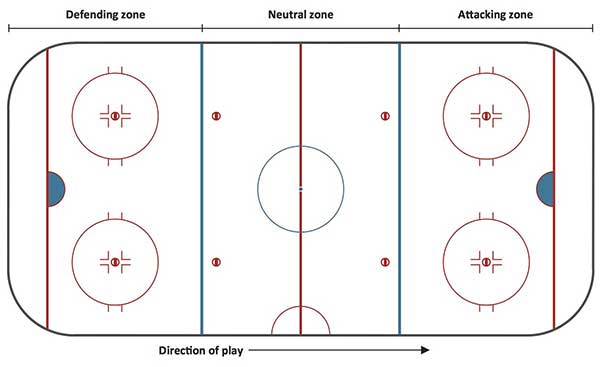
An ice hockey rink is divided into three main zones:
- Defending Zone — the team’s defensive area
- Neutral Zone — the middle area of the rink
- Attacking Zone — the area where a team is trying to score
The Blue Line is the key line used to determine whether a player is offside.
2. Basic Offside Principle
The basic rule is:
An attacking player must not enter the Attacking Zone before the puck.
When the puck completely crosses the Blue Line into the Attacking Zone, the position of the player’s skates is considered.
A player is On-side when at least one skate is:
- still touching the Blue Line, or
- still in the Neutral Zone
when the puck enters the Attacking Zone.
Therefore, both skates do not have to be completely behind the puck. If one skate is still touching the Blue Line, the player can remain on-side.
3. When Is a Player Offside?
A player is offside when:
- both skates have completely crossed the Blue Line into the Attacking Zone, and
- the puck has not yet entered the Attacking Zone.
In simple terms:
Player enters the zone first → Puck enters afterward = OFFSIDE
The important point is that the rule primarily considers the position of the skates, not the hockey stick.
4. Examples of Offside Situations
Example A — On-side
A player is positioned at the Blue Line:
- One skate is still touching the Blue Line.
- The other skate is in the Neutral Zone.
- The puck crosses the Blue Line.
Result: ON-SIDE
Example B — Offside
An attacking player has already entered the Attacking Zone:
- Both skates have crossed the Blue Line.
- The puck is still outside the Attacking Zone.
When the puck subsequently crosses the Blue Line:
Result: OFFSIDE
Example C — The Player Carries the Puck Into the Zone
There is an important exception.
If a player has possession and control of the puck with their stick before both skates cross the Blue Line, the player may carry the puck into the Attacking Zone without being offside, subject to the applicable rules.
In simple terms:
Player + Puck enter the zone together = Not Offside
5. Delayed Offside / Tag-up
Delayed Offside is a very common situation in ice hockey.
For example:
- An attacking player enters the Attacking Zone before the puck.
- The puck is still outside the zone.
- The Linesperson raises an arm.
- The attacking team has an opportunity to correct the situation.
This is known as a Delayed Offside.
The attacking players must clear the zone before they can legally continue the attack.
When Is Delayed Offside Cancelled?
Delayed Offside may be cancelled when the attacking players have properly cleared the Attacking Zone.
The Linesperson will lower the arm when the offside situation has been successfully cleared.
A delayed offside may also end when the defending team carries or plays the puck into the Neutral Zone, depending on the applicable rules.
6. What Players Must Not Do During Delayed Offside
While a Delayed Offside is in effect, attacking players must not:
- play the puck;
- attempt to gain possession of a loose puck;
- force a defending player who has possession of the puck to retreat into their own zone; or
- physically challenge or engage a defending player in certain circumstances.
If an attacking player interferes with play while the delayed offside is still active, the Linesperson can stop play and call Offside.
7. Shooting the Puck Into the Zone During Offside
This situation frequently occurs when a team performs a dump-in.
For example:
- An attacking player is already inside the Attacking Zone.
- A teammate shoots the puck into the zone.
- The Linesperson signals Delayed Offside.
- The attacking players must clear the zone.
The players can then re-enter and continue the attack once the offside situation has been properly cleared.
There are specific rules concerning a puck that is shot into the zone during an offside situation and subsequently enters the goal. Under IIHF rules, a goal may be disallowed in certain circumstances.
8. Intentional Offside
Intentional Offside occurs when a team deliberately causes an offside situation.
For example, a team may intentionally make an offside play to stop the opponent’s attack or obtain a stoppage in play.
Depending on the applicable rules, the resulting face-off may be moved to a less advantageous location for the team that caused the intentional offside.
9. Who Calls Offside?
The Linesperson is primarily responsible for determining offside.
Linespersons are responsible for situations involving:
- Offside
- Icing
- Face-offs
- Blue Line situations
- Entry into the Attacking Zone
One of the most recognizable signals is the raised arm used to indicate a Delayed Offside.
When the attacking team successfully clears the zone, the Linesperson lowers the arm to indicate that the delayed offside has been cancelled.
10. Offside vs. Icing
| Offside | Icing |
|---|---|
| Involves the Blue Line | Involves the Goal Line |
| Concerns entering the Attacking Zone | Concerns shooting the puck down the ice |
| Player enters the zone before the puck | Puck travels across the ice and crosses the Goal Line under applicable icing conditions |
| Usually signaled and judged by a Linesperson | Usually signaled and judged by a Linesperson |
| Controls entry into the Attacking Zone | Controls certain long-distance puck plays |
11. Why Is the Offside Rule Important?
The purpose of the Offside rule is to prevent attacking players from simply waiting near the opponent’s goal before the puck enters the zone.
Without the rule, players could gain an unfair advantage by positioning themselves close to the opposing goal and receiving easy passes or scoring opportunities.
The Offside rule helps promote:
- Fair Play
- Better team coordination
- Proper offensive zone entries
- Tactical play
- Balanced competition
- More organized gameplay
12. The Easiest Way to Remember Offside
🏒 Simple Formula
“The puck must enter the zone before the attacking player.”
Or simply remember:
PUCK → ZONE → PLAYER
However, if the player has possession and control of the puck and carries it into the Attacking Zone in accordance with the rules, the player may enter the zone without being offside.
Five Key Points to Remember
- Watch the skates, not the hockey stick.
- The puck must enter the Attacking Zone before the attacking player.
- If one skate is still touching the Blue Line, the player can be On-side.
- If both skates have completely crossed the Blue Line before the puck enters, it is Offside.
- Delayed Offside gives the attacking team an opportunity to clear the zone and correct the situation.
Important Note
Offside rules can vary depending on the governing organization and level of competition, including IIHF, NHL, USA Hockey, and youth hockey competitions.
For an official Ice Hockey Thailand rules guide, it is recommended to clearly state which organization’s rules are being used as the standard. The explanation above is based primarily on the IIHF Official Rule Book.