1. What is Charging?
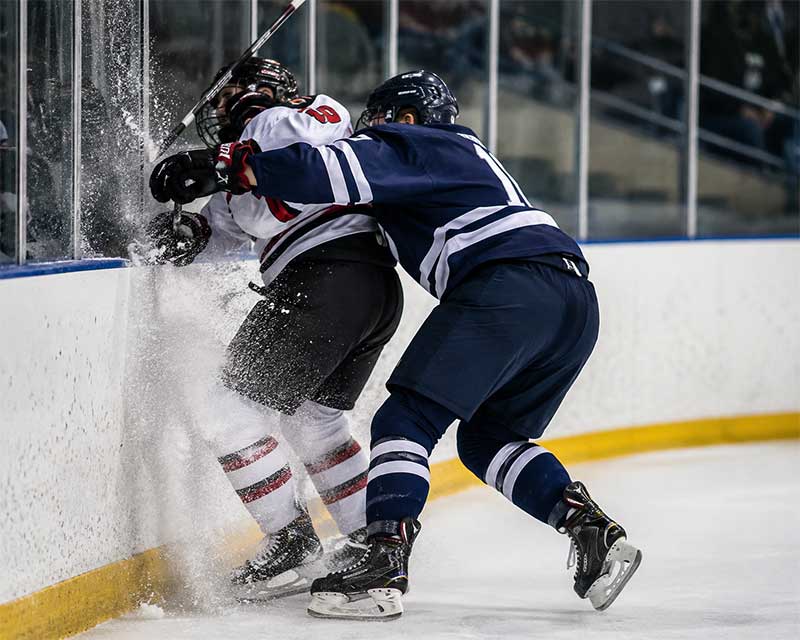
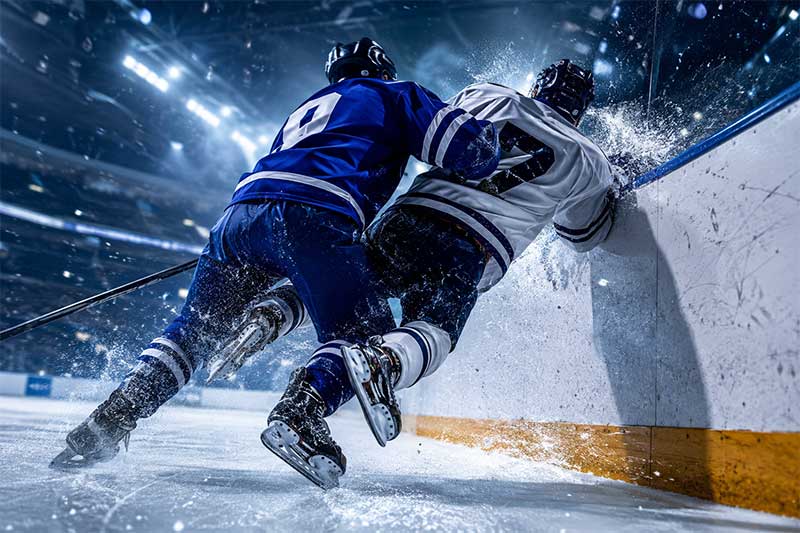
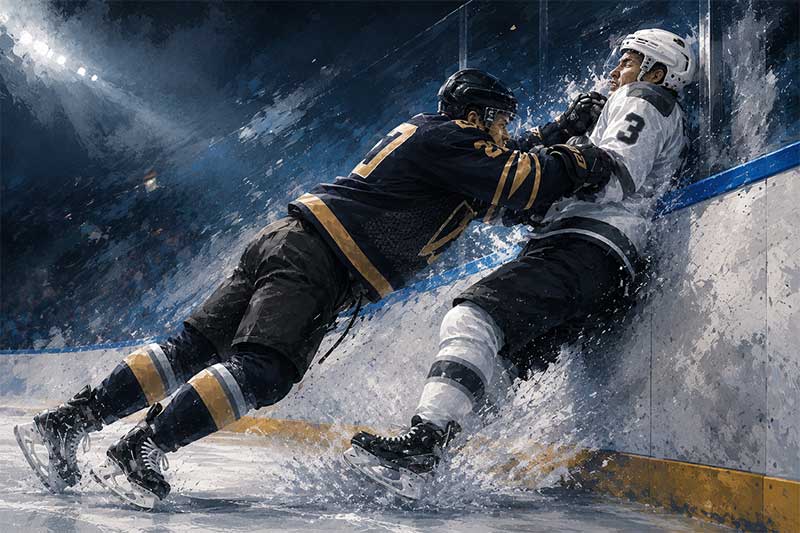
Charging is a physical infraction in ice hockey that occurs when a player delivers an illegal or excessive body check by building up speed, jumping, leaving their feet, or traveling an excessive distance immediately before making contact.
Under IIHF Rule 42, a player may be penalized for charging when the player approaches the opponent with excessive momentum or travels an excessive distance with the primary purpose of delivering the hit. A charge can occur against the boards, against the goal frame, or in open ice.
In simple terms:
Charging is not simply “hitting hard.” It is an illegal hit where the manner, momentum, distance, or violence of the hit makes the contact dangerous or unreasonable.
2. When Can a Hit Become Charging?
A body check can become charging when one or more of the following factors are present:
A. Excessive Distance
The player travels an excessive distance before making contact.
For example:
- A player sees an opponent several meters away.
- The player accelerates toward the opponent.
- The player continues skating toward the opponent solely to deliver the hit.
- The player makes violent contact.
The excessive distance and momentum can be factors in determining charging.
B. Excessive Momentum
A player may use excessive speed or momentum before the collision.
The important point is not simply how fast the player is skating. The referee considers how the player uses that momentum to deliver the check.
C. Leaving the Feet
A player who jumps or leaves their feet to deliver a hit may be subject to a charging penalty.
This is particularly concerning because the player can generate greater impact and has less ability to control the collision.
D. Violent or Dangerous Contact
A hit may be considered charging when the player violently checks the opponent in a manner that creates unnecessary danger.
The referee evaluates the degree of force and violence involved.
3. Charging Does NOT Mean Every Hard Hit Is Illegal
This is an important point.
Ice hockey is a physical sport, and legal body checking is permitted where the applicable competition rules allow it.
A hard check is not automatically charging.
The referee evaluates factors such as:
- distance traveled before contact
- speed and momentum
- whether the player left the feet
- degree of force
- violence of the contact
- location and circumstances of the hit
- whether the opponent was vulnerable
- whether another rule better describes the infraction
Therefore: Hard hit ≠ automatically Charging
but: Excessive momentum + excessive distance + dangerous/violent contact = possible Charging
4. Charging the Goaltender
Special attention is given to contact involving the goalkeeper.
Under IIHF rules, a player can be penalized for charging a goalkeeper while the goalkeeper is inside the goal crease.
However, a goalkeeper is not automatically “fair game” simply because they are outside the crease.
The referee must consider whether the contact was unnecessary.
Incidental contact may be permitted when the goalkeeper is playing the puck outside the crease, provided that the attacking player has made a reasonable effort to avoid the contact.
Example
Legal/possibly incidental: A goalkeeper leaves the crease to play a loose puck. An attacking player attempts to avoid the goalkeeper but minor incidental contact occurs.
Possible penalty: The attacking player deliberately drives through the goalkeeper or makes unnecessary contact despite having an opportunity to avoid it.
5. Referee Signal for Charging
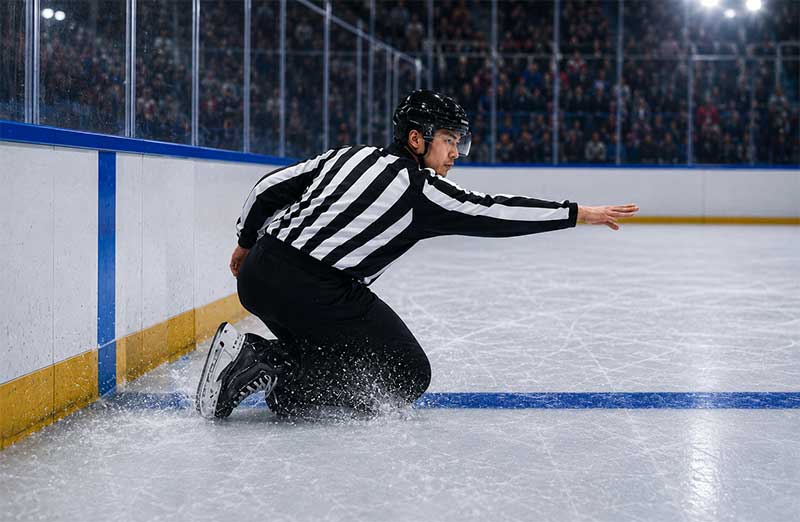
The official IIHF signal for Charging is:
The referee rotates clenched fists around one another in front of the chest.
This is the official signal specified under Rule 42 – Charging in the IIHF Game Official Signals.
How to recognize it
The referee:
- Raises attention to the infraction.
- Brings the fists in front of the chest.
- Rotates the clenched fists around each other.
This distinguishes Charging from other physical infractions such as:
- Boarding
- Checking from Behind
- Elbowing
- Clipping
- Kneeing
6. Why Is Charging Penalized?
The primary reason for penalizing charging is player safety.
A high-speed collision can cause serious injuries, particularly when:
- the opponent is near the boards;
- the opponent is not prepared for the hit;
- the player has built up excessive momentum;
- the player leaves the ice;
- the hit is delivered with excessive force.
Charging rules therefore help officials control dangerous physical play while still allowing legal body checking.
7. Penalties for Charging Under IIHF Rules
IIHF Rule 42 provides several levels of punishment depending on the seriousness of the incident.
Minor Penalty — 2 Minutes
The referee may assess a minor penalty for charging based on the degree of force and violence of the check.
Penalty: 2 minutes
This is the normal starting level for a charging infraction that does not rise to the more serious levels.
Major Penalty — 5 Minutes
A referee may impose a major penalty when the player recklessly endangers the opponent and a minor penalty would not be sufficient.
Penalty: 5 minutes
A major penalty is therefore associated with a significantly more dangerous charging incident.
Major Penalty + Game Misconduct
In a more serious case, the referee may assess:
5-minute Major Penalty + Game Misconduct
This may be applied when the player recklessly endangers the opponent and the referee determines that even a major penalty alone is insufficient.
The referee considers:
- severity of the infraction
- severity of the contact
- degree of violence
- overall reprehensibility of the action
Supplementary Discipline
The incident may also be subject to Supplementary Discipline by the appropriate authority.
This means the consequences can extend beyond the penalty imposed during the game.
8. Charging and Other Similar Infractions
Charging can sometimes look similar to other physical penalties.
It is important to distinguish them.
| Infraction | Main characteristic |
|---|---|
| Charging | Excessive distance/momentum or violent delivery of a check |
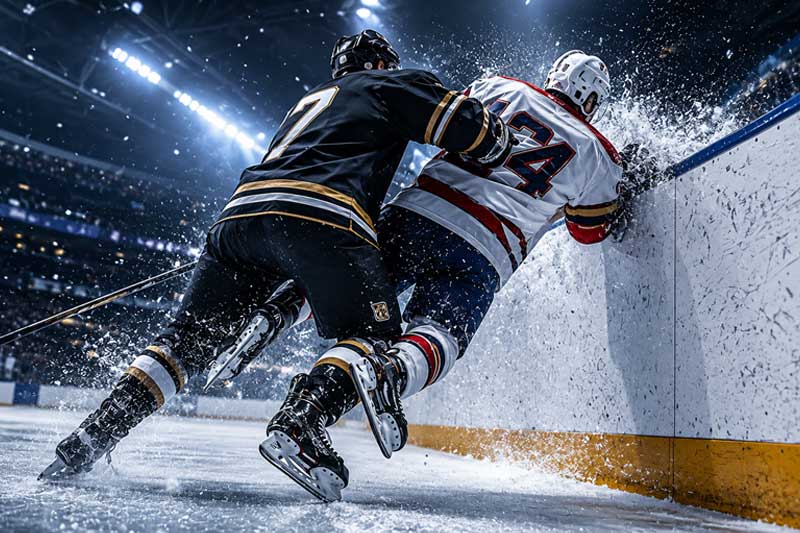
| Boarding | Dangerous contact that drives a player into the boards |
| Checking from Behind | Hitting a vulnerable opponent from behind |
| Elbowing | Using the elbow to make contact |
| Clipping | Contact directed at the opponent’s legs from a low position |
| Kneeing | Using the knee to make contact |
| Head Contact | Illegal contact to the head/neck |
| Roughing | Unnecessary physical altercation/contact |
IIHF specifically notes that an action involving unnecessary contact with a player playing an obvious icing or off-side play that results in that player hitting the boards is treated as Boarding. Where there is no board contact, the action may instead be treated as Charging, depending on the circumstances.
9. Charging vs. Boarding
This is one of the most important distinctions.
Charging
The primary concern is the manner in which the check is delivered.
Example : Player A builds up excessive speed and travels a long distance before violently checking Player B in open ice.
This can be Charging.
Boarding
The primary concern is that the opponent is driven dangerously into the boards.
Example: Player A checks Player B and Player B is driven violently into the boards.
This may be Boarding.
The exact classification depends on the circumstances and the referee’s judgment.
10. Charging vs. Checking from Behind
These are also different.
Charging
Focuses on: excessive distance + momentum + manner/violence of the hit
Checking from Behind
Focuses on: the opponent being hit from behind while vulnerable and unable to protect themselves.
IIHF defines checking from behind as a check delivered to a vulnerable player who is unaware of the impending hit and therefore unable to protect or defend themselves, with contact made on the back part of the body.
11. Warning Signs for Players
Players should recognize situations that can easily result in Charging.
Avoid:
❌ Skating a long distance solely to deliver a hit
❌ Accelerating directly into an opponent unnecessarily
❌ Leaving your feet to make contact
❌ Driving through an opponent with excessive force
❌ Making violent contact when the puck is no longer realistically playable
❌ Making unnecessary contact with a goalkeeper
❌ Continuing through a vulnerable opponent rather than controlling the check
Better approach:
✅ Keep control of your skating
✅ Maintain appropriate distance
✅ Make controlled contact
✅ Keep your feet on the ice
✅ Avoid unnecessary force
✅ Read the opponent’s position
✅ Be especially careful near the boards and goal crease
✅ Always consider player safety
12. Important Safety Principle
The fundamental principle is: A body check should be controlled, purposeful, and within the rules.
Players should not think:
“If I can hit the opponent, I should hit them as hard as possible.”
Instead:
“Make a legal, controlled check and avoid unnecessary risk.”
This is particularly important for youth and developing players.